 Remind is a great tool to help us keep CONNECTED in one more way!
I was just telling parents this week at open house that the sticky
labels that go home on your child's shirt don't always work for me
because I forget to stick them on! Plus, the labels don't always make
it home! Remind is a way that I can send you text message
reminders about special days, library books, popcorn sales, early outs,
etc. It is quick, easy, and safe. To sign up for my text
reminders text the message @69g67g to 81010. If you have any
questions or concerns about Remind, feel
free to ask! After open house, I had 5 families already registered in Remind. Awesome! I would love to have everyone on!
Remind is a great tool to help us keep CONNECTED in one more way!
I was just telling parents this week at open house that the sticky
labels that go home on your child's shirt don't always work for me
because I forget to stick them on! Plus, the labels don't always make
it home! Remind is a way that I can send you text message
reminders about special days, library books, popcorn sales, early outs,
etc. It is quick, easy, and safe. To sign up for my text
reminders text the message @69g67g to 81010. If you have any
questions or concerns about Remind, feel
free to ask! After open house, I had 5 families already registered in Remind. Awesome! I would love to have everyone on!

Sunday, September 11, 2016
Remind
Remind is a great tool to help us keep CONNECTED in one more way!
I was just telling parents this week at open house that the sticky
labels that go home on your child's shirt don't always work for me
because I forget to stick them on! Plus, the labels don't always make
it home! Remind is a way that I can send you text message
reminders about special days, library books, popcorn sales, early outs,
etc. It is quick, easy, and safe. To sign up for my text
reminders text the message @69g67g to 81010. If you have any
questions or concerns about Remind, feel
free to ask! After open house, I had 5 families already registered in Remind. Awesome! I would love to have everyone on!

Cooperation


Now in our third week of school, we have certainly gotten to some academic tasks; however, we are still working on building a strong classroom community of respect and manners. This week we focused on cooperation. We read a couple books that highlight cooperation. For example, Swimmy by Leo Lionni. If you click on the title, you can link up with a video of the book. We did some cooperation challenges to work as a team. In the hula hoop challenge, we worked as a class to pass the hula hoop through the entire circle without letting go of hands! The class did awesome working as a team and encouraging each other. We also put the word cooperate in our vocabulary notebook. I was so impressed that many of the children used classroom examples of cooperation to illustrate the word. Some students drew the example from Swimmy, some drew the hula hoop challenge, and others did the creating of the puzzle from the first week of school. I just love our Connected Combo!


Fiction and Nonfiction
During our study on the oceans, we have been learning to distinguish between fiction and nonfiction texts. The students are getting very good at not only telling you if a book is fiction or nonfiction but also showing you evidence to support their thinking. In the pictures below, students are sorting books into fiction and nonfiction and explaining their thinking to their group members. Second graders also went through our recent book orders to do some sorting.


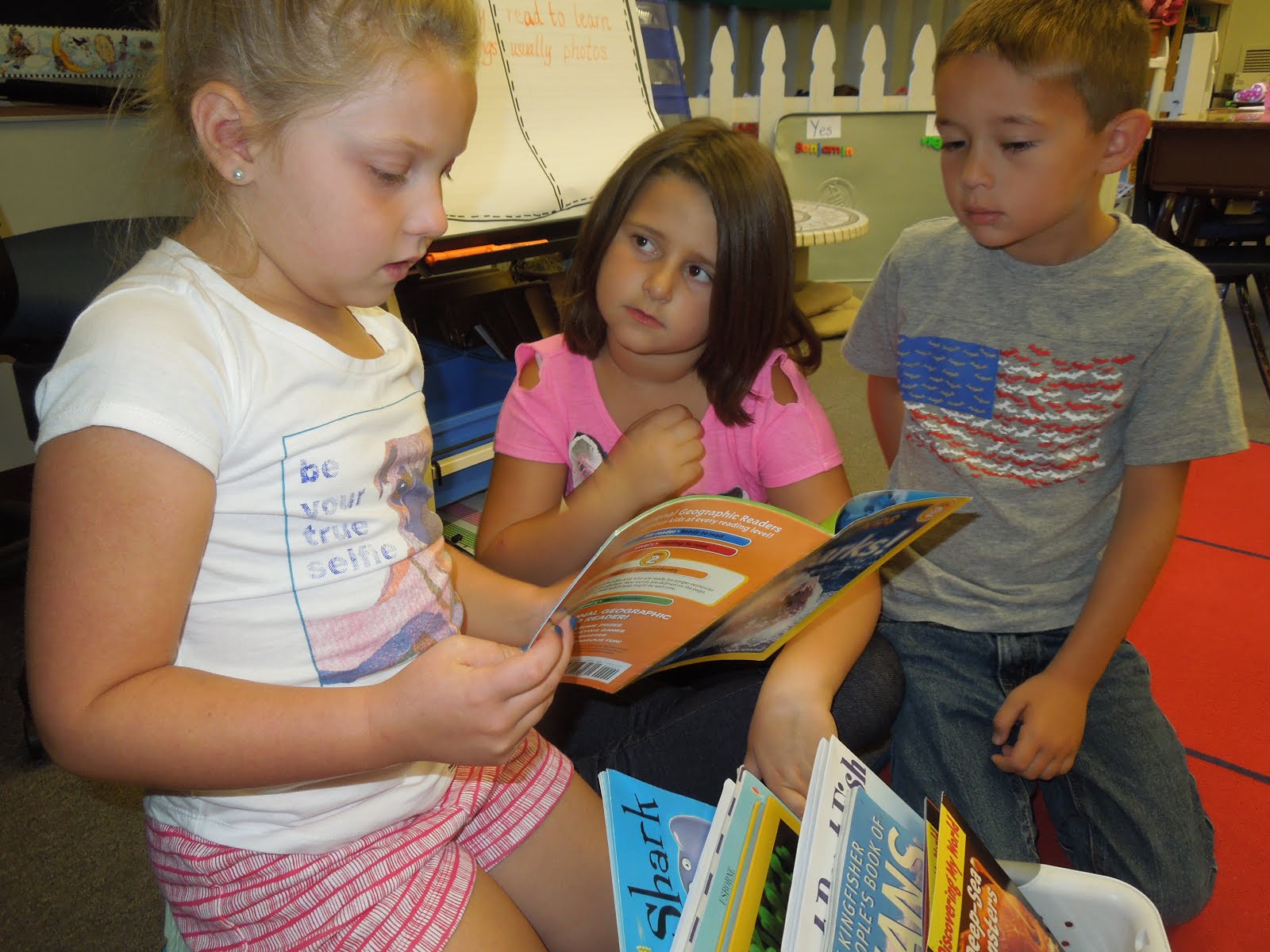
We made a class anchor chart with some of the defining characteristics of fiction and nonfiction texts. Students also demonstrated their understanding of fiction and nonfiction in their vocabulary notebooks.


While making the fiction/nonfiction distinction is a first grade performance standard, we dove a deeper into the second grade standard of knowing different features of nonfiction text and how those features help locate important information.


To discover different features of nonfiction text, we have been going fishing! Inside a fishing net I have placed examples of different nonfiction features like a caption, map, diagram, bold print, headings, etc. A student comes up and sticks their hand in the net to grab a feature. They have to be quick though, the fish are fast and slippery and you always have to be careful of being bit! Ha! Mr. Palmer knows how to build suspense...can't you hear him humming the Jaws theme?


We will continue to explore more features into next week. When you are reading at home, ask your child if the books are fiction or nonfiction and listen to their reasoning skills. See if they can point out any features.
Saturday, September 10, 2016
Goodness Graphness


The Connected Combo mathematicians have been working extremely hard at organizing, representing, and interpreting data in a graph, an important common core standard in both first and second grade. In fact, our entire hallway is covered in different graphs about the class. We have had very rich mathematical discussions about our data.


Sunday, September 4, 2016
Even or Odd

For second grade math, we are starting by developing number sense and exploring place value concepts. This week we focused on determining if a number is odd or even. We read a delightful story called Even Steven and Odd Todd. From the story, we realized even numbers can be paired. We found a pattern that even numbers end in 2, 4, 6, 8 or 0. Odd numbers have 1, 3, 5, 7, or 9 in the ones place.
We played a couple of different dice and domino games where students found sums and sorted the sums by odd or even. We also made an anchor chart to help us remember the rules we were discovering.


On Friday, we started to explore the last part of this objective "can write an equation to express an even number as a sum of two equal addends." For instance, 6 (an even number) can be expressed as 3+3. I gave the students a plate full of fruit loops. They had to see if they could evenly divide the fruit loops into two equal piles. If they could, they gave the plate to Even Steven, if not...the plate went to Odd Todd. This proved to be a little more difficult and we will need to continue to practice this concept in the upcoming week. However, this activity was a tasty introduction!


Subscribe to:
Posts (Atom)