Knowing 10 facts is hugely important for future success in mathematics.
We have been practicing ten in many different and fun ways. Take a look! We built Ten Fact Rainbows to help the students memorize the very
important ten facts. We built stacks of ten and then made a rainbow
poster to tie the learning together and give the students a great
visual.
Look how much the students are learning about math! Do you remember learning thecommutative property in first grade? Not only do these six year olds know the commutative property for addition, they can also demonstrate it without blinking an eye!
After each student had a Ten Fact Rainbow, the students used
the rainbows to play a game called "Ten Grab." In the video below, two
girls are using the rainbow to play. In "Ten Grab," player one rolls
the die. If the student rolls a 4,
he/she would take 6 cubes because 6+4=10. Play continues until the
cubes are gone. The student with the most cubes is the winner.
The students also really enjoyed this rap. There are several mathematicians that don't miss a beat during this fast-paced ten song.
Argh! We had such a great "Talk Like a Pirate Day" on Monday. Our whole wing, 1st and 2nd grades, dressed up to celebrate. The official "Talk Like A Pirate Day" was on Saturday. Click here to learn the history of "Talk Like a Pirate Day." Even a couple days late, we had fun, pirate-y learning going on all day. The day began by choosing pirate names. They were pretty silly. The students had new names like Big Buckle Charlie and Fearsome Pegleg Patsy. Some students put their pirate name on all their papers! Ha! It sure made correcting papers a little more interesting!
In math, we counted and tallied pirate objects. The children worked cooperatively in pairs. They understood how to work as a crew! We also learned to add like a pirate with this video that includes awesome story problems.
Later, we folded some pirate hats and learned about the "ar" chunk. We filled our hats with "ar" words and practiced reading and spelling all the words. Then, we tested our ability to read "ar" words with a Q-arrrrr hunt. In the QR hunt, the students scanned QR codes with their ipads. The QR code revealed a word. Students had to read the word and find the picture of the word. When they found the picture, there was another QR code. The students completed the series of clues on the first try! They were an awesome crew!
Toward the end of the day....we found a secret map! We had to use the map to find some letters, then unscramble the letters to find the treasure. The letters said GOLD! At recess, we ran all over the playground looking for pirate clues and gold. The children found clues but no gold.
A disappointed crew reentered the classroom to find....GOLD! Golden snacks anyway. It made for a yummy treat at the end of the day!
Our day was filled with learning and fun. We read all sorts of wonderful pirate books, made a pirate graph, played new pirate apps, and all sorts of interesting things. There are two great pirate apps, one for spelling and one for math. Check out Pirates Love to Count and Pirates Love to Read in the App store. Click on the names of the apps to find more information. Yo, ho, ho!
Our third science lab this week was an actual experiment. In this experiment, the scientists had to follow step by step directions, make predictions, and record their findings. However, the best part of this experiment is it had the children EXCITED about science!
Each scientist trio had a plate of milk with drops of food coloring, a Q-tip, and a small cup with dish soap. The students were to dip the Q-tip in the soap and then in the food coloring to see what would happen. Some of the predictions were the milk would bubble, the plate would start smoking, and the colors would make a rainbow. Here is what did happen:
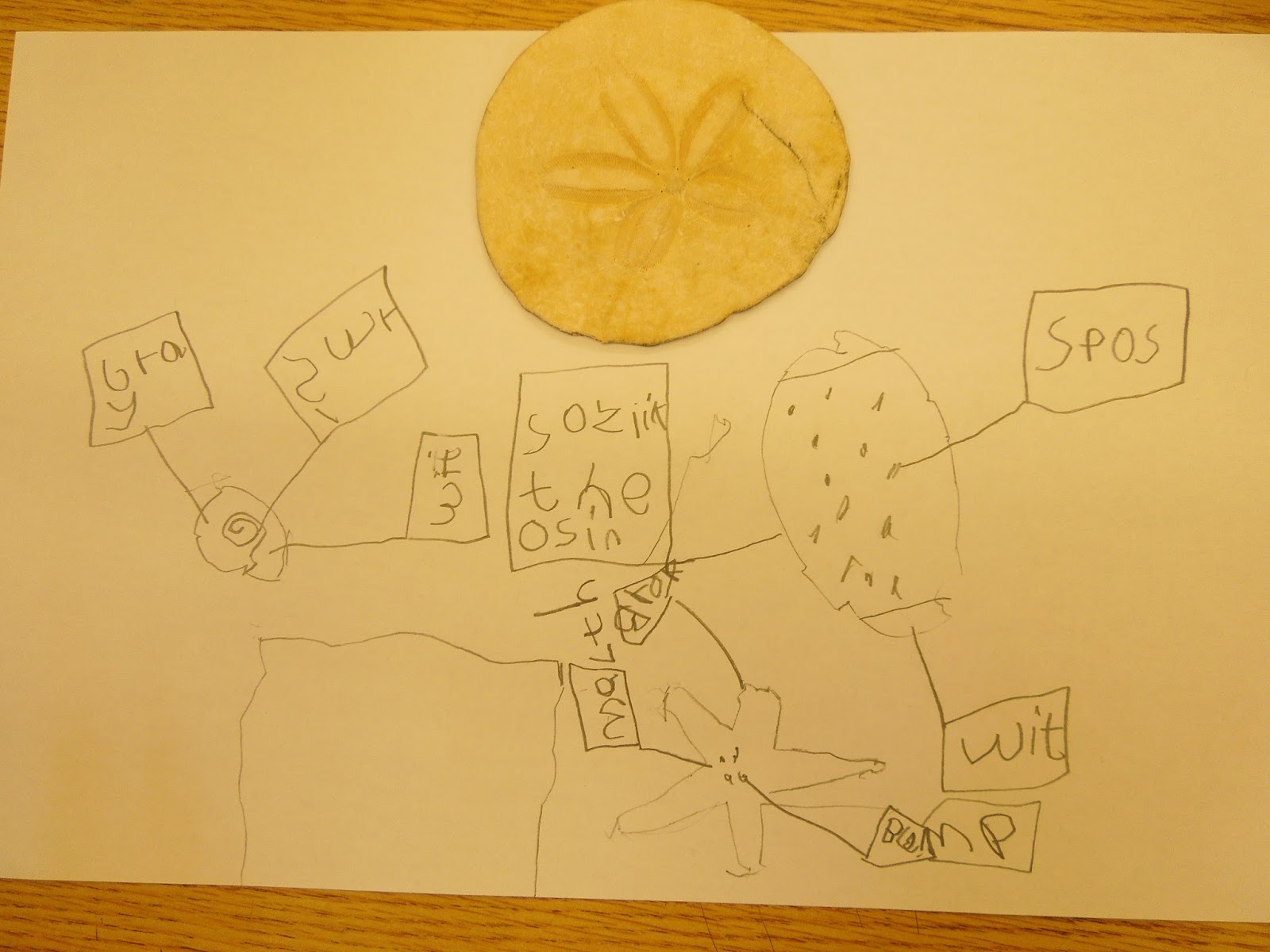
Continuing with a focus on what scientist do, we did some shell science this week. We discussed that scientists use different tools to study the world around them. One important tool is a magnifying glass and another....paper and pencil! We used magnifying glasses and our science notebooks to record our observations about seashells. The scientist were really noticing the details. In reading, we have been talking about features of nonfiction. One
feature we have discussed is labels. Writing
the labels was also a great opportunity to practice segmenting sounds
like we have been in phonics. Look at all their hard work!
When I think of science, I usually think of hands on experiences, but there are a few great science apps available. We have explored an app with Sid the Science Kid in class. The app allows students to engage in and practice important science skills like sorting and classifying, identifying patterns, charting, noticing details, and sequencing. Click here to be linked to more information about the app. Our first grade scientists LOVE this app!
We have been using the ocean theme to learn and practice tons of different reading foundational skills. The children are loving the fiction and nonfiction books shared during read aloud. For vocabulary, we learned the word aquatic. Aquatic means living in or happening in the water. See if your child can give you some examples and non examples of aquatic. Here is one smart first grader's picture of aquatic in her vocabulary notebook. She definitely can think of several great examples of aquatic.
We also used the aquatic theme to practice an important phonics and spelling skill. When writers come to tricky words they don't know how to spell, they need to be able to segment the word into the sounds. We learned a strategy called push and say. In this strategy, we use the length of our arm to tap out how many sounds are in a word. For instance, fish has three sounds: /f/- /i/- /sh/.
After we figure out how many sounds in the word, we make that many boxes. Then, the writers figure out what letters to add to the boxes. Watch this awesome speller segment the sounds of fish and push the letters to the correct boxes.
After we practiced segmenting and pushing up several different words together, the students set to work independently. The children had to pick four different aquatic animals to segment and spell. The students were excellent and hearing the sounds in words.
Last, but not least, we published our own books about Aquatic Animals. We used the tricky words that we figured out how to spell in our books. Besides practicing segmenting tricky words, the students also got practice writing sentences. Students had to remember to begin sentences with a capital letter, use spaces between words, and end with proper punctuation. What fantastic writers!